
What happens when students are given the opportunity to sit down with an older adult, ask questions, listen carefully, and discover the story of another person's life?
At first, it can feel a little unfamiliar. A student might wonder what they will possibly talk about with someone several generations older. An older adult might wonder how they will connect with a group of 11 or 12 year olds.
Then the conversation begins.
A question about childhood becomes a story about growing up in another time or place. A discussion about school leads to comparisons between generations. A photograph sparks a conversation about travel, family, work or change.
And gradually, something shifts. The person sitting across the table is no longer simply a "senior" or a "student."
They become a GrandPal.
Learning Through Another Person's Story
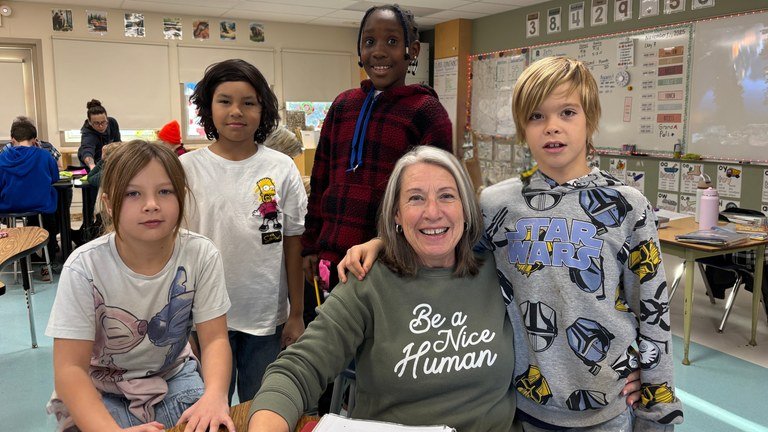
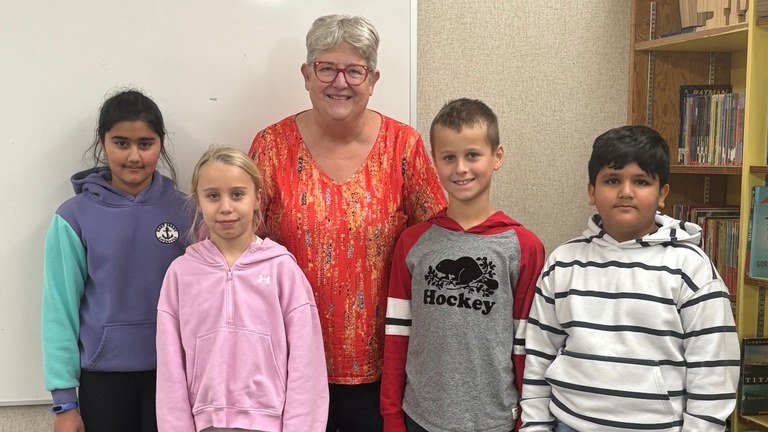
GrandPals is an intergenerational learning program that brings older adults and students together through a series of guided conversations. Students typically work in small groups with one older adult. Over several weeks, they explore themes such as home, family, learning, work, technology and travel.
Their goal is ultimately to tell the story of their GrandPal through writing and original artwork. But the finished story is only part of the learning.
- Students have to learn how to ask a thoughtful question.
- They have to listen closely enough to recognize when an answer contains another story worth exploring.
- They learn to follow a conversation rather than simply work through a list of questions.
- They also begin connecting what they are hearing to things they are learning in school.
One GrandPal might describe immigrating to Canada. Another might talk about working on a farm, growing up without today's technology, travelling across the world or navigating a difficult period in their life.
Geography, history, literacy and social emotional learning suddenly have a human face.
In one GrandPals community, conversations about past experiences naturally led to discussions involving maps, travel, culture, navigation and even mathematics. As one GrandPal reflected, students allowed him to see his own life again through their eyes.
Relationships Change the Learning
Perhaps the most powerful part of GrandPals is that the learning goes in both directions.
They are learning about one another. That distinction matters.
In Montreal, educators involved with the WIN Intergenerational Network noticed that some students who struggled in more traditional classroom settings seemed to find their voice in the smaller GrandPals conversations. As the weeks progressed, conversations became more natural and relationships deepened.
In Flagstaff, Alberta, one student returned from a GrandPals session excitedly declaring how much he liked his GrandPal. Another student spent an entire session talking with an older adult about childhood memories and an artifact she had brought from New Zealand.
These can seem like small moments. But they are the moments from which relationships are built.
Learning to See Beyond Age
Intergenerational learning also creates an opportunity to challenge assumptions. Students may enter the program with ideas about what an older person is like. Older adults may arrive with their own ideas about today's young people.
Repeated interaction makes those broad assumptions much harder to maintain because participants begin seeing one another as individuals.
GrandPals' multi-year evaluation has found evidence of these kinds of outcomes. Teachers and facilitators reported changes in areas including patience, compassion, interpersonal skills and assumptions about aging.
Evaluated program, 2022–2025 academic years
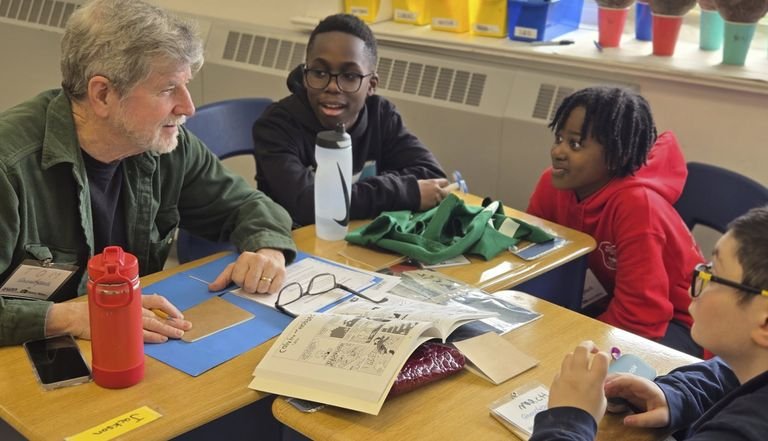
But some of the clearest evidence is visible in the room. Students begin leaning forward. Questions become follow-up questions. Laughter starts travelling across the table. Nobody is watching the clock.
Stories Worth Preserving
Near the end of a GrandPals cycle, students begin turning everything they have learned into something lasting. They write. They revise. They choose which moments best represent the person they have come to know. They create artwork. And eventually, they give that story back to their GrandPal.
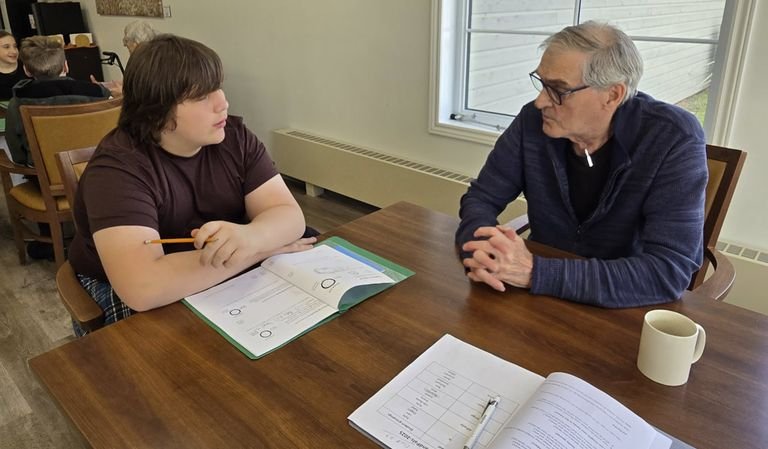
There is something powerful about an older adult seeing their life interpreted through the eyes of a young person.
The biography says, in effect:
I listened.
Your experiences mattered.
Your story was worth telling.
And for students, writing suddenly has a very real audience. They are not completing an assignment that disappears into a folder after it has been marked.
They are responsible for somebody else's story. That changes the work.
From One Classroom to a Growing Network
GrandPals began as a school-based initiative in Orangeville, Ontario, in 2010. What started with teachers connecting students and older adults locally has gradually grown into something much larger. Today, communities are implementing GrandPals through partnerships involving schools, libraries, retirement communities, charities, municipalities and organizations serving older adults.
The model is intentionally local. The relationships belong to the community. GrandPals provides the structure around those relationships: volunteer orientation, classroom materials, coordinator resources, student activities and a platform that enables communities to organize and support their programs.
That means the program can look slightly different from place to place while preserving the same essential idea.
- Bring generations together.
- Give them enough time to move beyond introductions.
- Provide thoughtful questions and meaningful work to do together.
- Then allow the relationship to take over.
Sometimes the Simplest Learning Is the Most Powerful
Education increasingly gives students access to extraordinary amounts of information. They can explore virtually any place. They can search almost any question. They can learn from people around the world. All of that matters.
But there remains something uniquely powerful about sitting across from another human being and saying:
Tell me about your life.
Then listening.
For an educator, that deceptively simple experience can open the door to literacy, oral communication, history, geography, identity, empathy and citizenship. For an older adult, it creates an opportunity to contribute, reflect and build a meaningful relationship with a younger generation.
And for both? It can create a friendship neither expected.
That is the heart of GrandPals.
About GrandPals
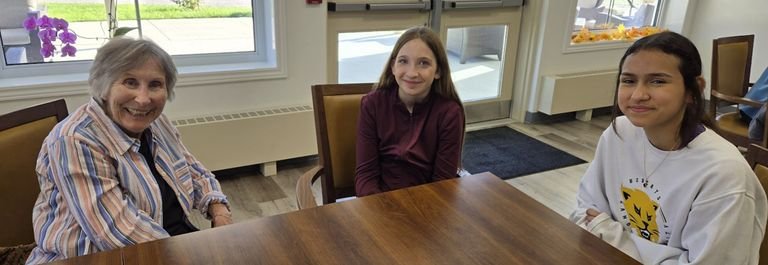
GrandPals is an intergenerational learning program connecting older adults with students through storytelling, conversation, writing and art. Schools and community organizations across Canada are using the program to create meaningful relationships between generations while supporting student learning and strengthening community connection.
Learn More About GrandPals